Multilingual Driver Recruitment: Eliminating Language Barriers in Cross-Border Hiring
SHARE

How does automated multilingual candidate screening solve language barriers in cross-border driver recruitment?
Automated multilingual candidate screening solves language barriers in cross-border driver recruitment by utilizing conversational AI chatbots that interact with international candidates in their native languages (such as Ukrainian, Russian, Belarusian, Polish, German, and English) and translate responses in real-time. In the European transport sector, where carriers and driver-staffing agencies source drivers from diverse regions to fill empty cabs, manual screening is severely bottlenecked by language barriers and high translation costs. A conversational assistant like the CE.D Global driver chatbot automates this qualification triage—assessing professional licenses and testing conversational language proficiencies—before booking pre-screened, compliant candidates directly into a recruiter's calendar.
The Multilingual Reality: Navigating Europe's Cross-Border Talent Pool
The European logistics and transport sector is structurally dependent on international labor. With the International Road Transport Union (IRU 2025) reporting over 502,000 unfilled HGV driver positions across Europe, and Germany alone facing a deficit of 120,000+ drivers (BGL 2026), carriers can no longer rely solely on domestic sourcing.
To keep their fleets moving, logistics hubs and driver-staffing agencies in Poland and the Baltics act as essential gateways. Poland, where heavy-duty drivers are in severe deficit across 331 of 380 regions (Barometr Zawodów 2025), has become a primary hub for recruiting and deploying drivers from Ukraine, Belarus, and Central Asia to cover long-haul routes stretching from Warsaw to Madrid and Berlin. However, this cross-border sourcing model introduces a massive operational hurdle: the blue collar language barrier.
When a Baltic or Polish fleet attempts to hire a candidate from Central Asia or Eastern Europe, communication frequently breaks down at the very first step. If the candidate cannot speak basic Polish, Latvian, German, or English, a standard recruiter cannot evaluate their suitability over a phone call. This communication gap delays the hiring cycle, increases recruitment costs, and risks placing drivers on the road who cannot read critical cargo documents or communicate with dispatchers. Sourcing at scale requires a dedicated system for cross border driver recruitment that integrates real-time conversational translation.
Sourcing the "Languages Spoken" Field: The Recruiter's Ultimate Filter
For international freight transport, a driver's language capability is not a soft skill, it is a critical logistics candidate qualification and compliance requirement. Drivers must be able to:
Understand Dispatcher Instructions: Follow route changes, scheduling adjustments, and safety alerts communicated via mobile devices or onboard telematics.
Handle Border and Customs Paperwork: Present and explain CMR consignment notes, ADR declarations, and customs documents at checkpoints.
Navigate Local Facilities: Communicate effectively with warehouse workers, forklift operators, and port authorities during loading and unloading.
For recruiters, verifying "languages spoken" is the single most operationally decision-relevant screening step. If a driver cannot speak at least basic English or German, they cannot be deployed on high-revenue Western European transit corridors.
Yet, traditional telephone screening of international candidates is incredibly labor-intensive. Recruiters spend hours playing phone tag, struggle to understand varying accents, and must hire expensive multilingual staff just to conduct initial qualification checks. This manual screening creates a severe pipeline bottleneck, slowing down candidate onboarding and leaving expensive trucks idle.
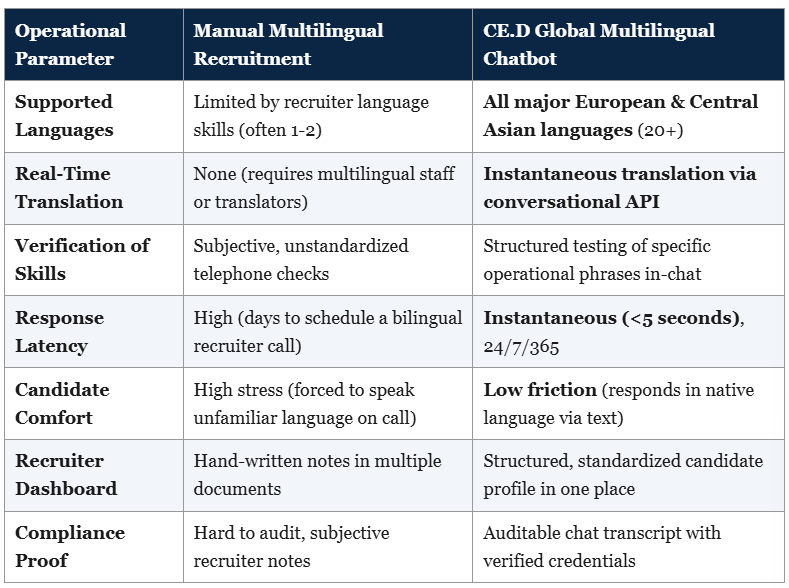
Structured Comparison: Manual Multilingual Sourcing vs. CE.D Global Chatbot Translation
The table below outlines the operational differences between manual multilingual recruitment and automated candidate qualification using CE.D Global:
The CE.D Global Solution: Multilingual WhatsApp Conversational Automation
To resolve these international hiring bottlenecks, CE.D Global has designed a specialized, multilingual WhatsApp Candidate-Screening Chatbot. The bot acts as an intelligent translator and screening assistant, meeting candidates on their preferred messaging application "WhatsApp" which is universally used by long-haul drivers across Europe and the CIS regions.
Frictionless Multi-Language Conversational Flow
When an international driver initiates a chat (by scanning a QR code on a trailer or clicking a social media add), the CE.D Global chatbot automatically identifies their language or asks them to select their preferred tongue: [English], [Deutsch], [Polski], [Українська], or [Русский].
The entire qualification dialogue is conducted in the driver's native language. The driver feels comfortable and confident, leading to an extremely high completion rate (under 15% drop-off compared to the typical 90% drop-off on web portals).
The bot gathers all relevant operational data:
Driving License: Checks for Articulated Truck (C+E) license and extracts physical details via OCR.
Certifications: Confirms Code 95 and ADR compliance.
Language Proficiency Test: The bot dynamically tests their language capabilities by asking them to translate simple, practical transport phrases. For example: "Please translate this instruction into basic German: 'Deliver the temperature-sensitive cargo to Munich by Friday morning.'"
Automated Dashboard Translation for Recruiters
While the candidate interacts with the bot in Ukrainian or Russian, the recruiter does not need to speak these languages to manage the pipeline.
CE.D Global's automated compliance triage engine translates all the driver's responses back into the recruiter's native language (e.g., Latvian, Polish, German, or English) in the central dashboard. The recruiter sees a clean, standardized profile stating the driver's verified licenses, years of experience, and a calculated score for their "languages spoken" filter.
If the driver is qualified, the bot automatically schedules them for a follow-up interview, matching their calendar with the recruiter's availability.
