Chatbots vs Voice Bots: Why WhatsApp Recruitment Beats Robocalls
SHARE

What is the difference between recruitment chatbots and voice bots in high-volume hiring?
Recruitment chatbots are text-based, asynchronous conversational systems (such as WhatsApp bots) that screen candidates via messaging, whereas recruitment voice bots are automated, interactive voice response (IVR) or telephony systems that conduct screening via automated phone calls. Text-based chatbots are overwhelmingly superior for high-volume recruitment because they eliminate telephony overhead, solve ambient noise issues, reduce Word Error Rate (WER) to zero, and offer near-zero latency, enabling instant, multilingual candidate qualification at a fraction of the cost of voice bots.
1. Introduction: The Frontline Recruitment Bottleneck
In high-volume frontline staffing, covering logistics, retail, hospitality, and healthcare, recruitment is a race against time. Sourcing velocity is the primary determinant of fleet capacity and operational throughput. Yet, many organizations remain trapped in an outdated debate: should they automate their phone screening using voice bots (robocalls), or should they deploy asynchronous, text-based chatbots on messaging channels like WhatsApp?
Historically, voice has been viewed as the gold standard of human interaction. However, when applied to high-volume blue-collar and frontline sourcing, telephony-based voice bots introduce immense friction, high operational costs, and technical barriers that decimate candidate conversion rates. In contrast, text-based conversational AI chatbots integrated with popular messaging platforms offer a frictionless, highly accurate, and extremely cost-effective alternative. This article provides a comprehensive technical and operational comparison, demonstrating why text-based WhatsApp automation wins the high-volume sourcing war.
2. Structured Technical Comparison: Chatbots vs. Voice Bots
The table below outlines the core technical and operational differences between text-based chatbots and telephony voice bots:
3. The Technical Realities: Word Error Rate (WER) and the Ambient Noise Problem
Why Voice Bots Fail in Frontline Environments
Voice bots rely on a complex cascade of technologies: Automatic Speech Recognition (ASR) to convert voice to text, a Natural Language Processing (NLP) or LLM engine to interpret the text, and Text-to-Speech (TTS) to deliver a vocal response. Every step in this chain introduces errors.
The primary point of failure is the ASR engine, measured by Word Error Rate (WER). In pristine laboratory conditions, modern ASR engines can achieve a WER of 4% to 6%. However, frontline candidates, such as delivery drivers, warehouse operators, and retail workers, are rarely in pristine, silent rooms when they receive a call. They are frequently driving, working in loud warehouses, walking on busy city streets, or managing household activities.
In these environments, ambient background noise, wind, and voice compression over standard cellular networks (such as AMR-NB codecs) cause ASR engines to misinterpret key details. Regional accents and dialects further degrade accuracy. A voice bot attempting to capture a driver's CDL license number or ADR certificate details will experience a WER of 12% to 25%, leading to conversational breakdown, frustration, and high candidate drop-off.
How Text Chatbots Achieve 0% WER
Text-based WhatsApp chatbots eliminate the entire ASR/TTS pipeline, reducing the WER to 0%.
Candidates interact using their native keyboard or by selecting structured quick-reply buttons (e.g., "Yes," "No," "Class A CDL"). Because the input is already in digital text format, there is no risk of phonetic misinterpretation. If a candidate needs to provide complex data, such as a license plate, certificate number, or postal code, they can type it directly or upload a photo of the document. The chatbot can then use optical character recognition (OCR) or document-parsing APIs via webhooks to verify the document with perfect accuracy. This direct text interface ensures that the candidate's exact intent is captured every time, without ambient noise interference.
4. Telephony Overhead and Latency: The Silent ROI Killers
SIP Trunks, Carrier Billing, and Connection Drops
Voice bots require a complex, expensive telephony infrastructure. To make automated phone calls, organizations must provision Session Initiation Protocol (SIP) trunks, negotiate carrier agreements, and pay per-minute billing rates. Furthermore, telephony-based screening is highly synchronous; if a candidate does not answer their phone, the call is sent to voicemail, requiring the bot to retry or forcing a human recruiter to follow up manually.
Call drop rates are exceptionally high due to cellular coverage gaps, "Spam Risk" labels on outbound numbers, and candidate reluctance to answer unsolicited calls. This telephony overhead drives up the cost-per-contact and dramatically reduces sourcing velocity.
In contrast, WhatsApp utilizes the candidate’s data connection, operating via highly efficient HTTPS API Webhooks. WhatsApp Business API pricing is based on a flat, conversation-based model rather than a per-minute rate. When a candidate initiates or responds to a chatbot conversation, the message delivery is guaranteed, asynchronous, and incurs zero telephony connection overhead.
The "Pause of Death": High Latency in Voice LLMs
Human conversation is incredibly rapid, with typical turn-taking gaps of just 150ms to 250ms. For a voice bot to feel natural, it must respond within this window. However, the computational latency of a voice bot includes:
Audio streaming latency (SIP/WebRTC packet transmission)
ASR processing time (Speech-to-Text conversion)
LLM inference latency (Generating a response)
TTS synthesis time (Text-to-Speech conversion)
Even with optimized LLMs and fast hardware, this multi-step pipeline has an average voice bot latency of 1.5 to 3.0 seconds. This "pause of death" creates awkward silences, leading candidates to believe the call was disconnected or causing them to speak over the bot, which triggers a complete disruption of the conversation stream (known as voice barge-in failure).
Text chatbots completely bypass this latency constraint. Because messaging is inherently asynchronous, a response latency of 500ms feels instantaneous to a user typing on a phone, and even a 1-second delay is perfectly acceptable. WhatsApp recruitment automation allows for rapid, natural back-and-forth interactions without the heavy computational and network latency of voice-processing pipelines.
5. Solving Conversational Drift and Preserving Contextual Memory
Conversational Drift in Voice vs. Text
During a phone screening, candidates often go off-topic, ask clarifying questions, or change their minds mid-sentence. This behavior leads to conversational drift, where the conversation deviates from the structured qualification pathway. When a candidate drifts during a phone call, voice bots struggle to parse the interruption and re-route the candidate back to the key questions. If the bot interrupts the candidate or loses track of its current screening objective, the interaction fails.
Using LlamaIndex and Vector Databases to Prevent Conversational Drifting
Text-based chatbots handle conversational drift by maintaining a robust contextual memory. By integrating tools like LlamaIndex, the chatbot can convert the candidate's chat history into vector embeddings and store them in a lightweight vector database.
When a candidate asks an off-topic question (e.g., "Do you pay weekly or monthly?" in the middle of a safety screening), the chatbot can perform a semantic search against the company’s knowledge base, answer the question accurately, and immediately return to the active screening node:
> Candidate: "Wait, is this job near the Warsaw hub?"
> Chatbot (Querying LlamaIndex): "Yes, this role is based at the Warsaw hub, which has free parking. Let's get back to your licenses: Do you hold a valid ADR certificate?"
This architectural setup ensures the chatbot never loses track of the screening flow, resulting in higher data completion rates and a seamless candidate experience.
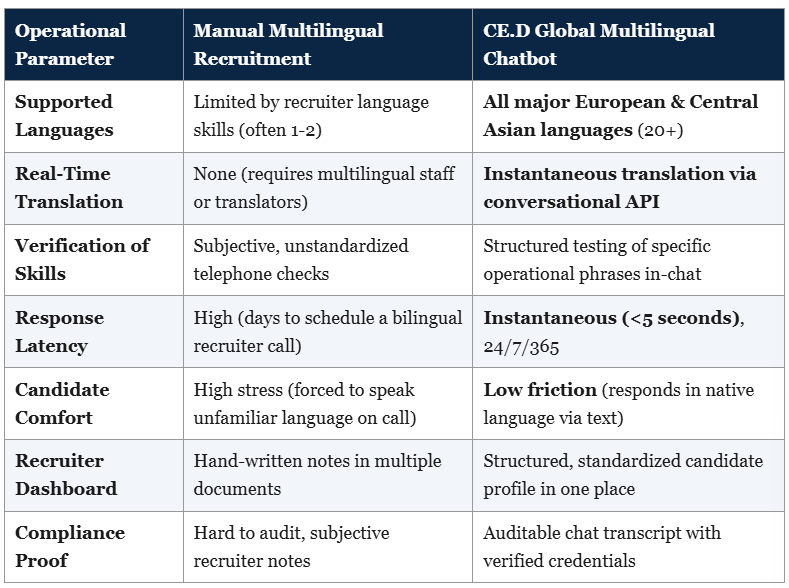
6. Multilingual Recruiting: Breaking the Translation Barrier
The modern frontline workforce is increasingly international. In Europe, logistics and transport heavily depend on cross-border workers. For instance, Poland’s Barometr Zawodów 2025 highlights severe deficits in domestic HGV drivers, forcing transport firms to source drivers from Ukraine, Belarus, Georgia, and Central Asia. In Germany, the BGL 2026 report projects a deficit of over 120,000 professional drivers, making multilingual sourcing a survival requirement for logistics operators.
A voice bot attempting to handle multilingual candidates faces insurmountable obstacles. It must detect the candidate's language, switch its ASR and TTS engines on the fly, and successfully handle heavy regional accents and phonetic variations.
Text-based WhatsApp chatbots handle translation effortlessly. Messages can be routed through real-time neural translation APIs before hitting the LLM, and the response can be translated back to the candidate's native language in milliseconds. A Polish logistics firm can run a screening flow where the bot sends messages in Ukrainian, translates the candidate's replies to Polish for the recruiters, and maintains perfect technical accuracy throughout.
7. Channel Psychology: Why Frontline Workers Ignore Robocalls
The rise of spam calls, spoofed numbers, and aggressive telemarketing has fundamentally altered consumer behavior. Frontline workers, particularly younger generations, actively avoid picking up phone calls from unknown numbers. Robocalls are immediately flagged as spam by iOS and Android dialers, resulting in contact rates of less than 20% for outbound voice campaigns.
WhatsApp, on the other hand, is a trusted channel where users communicate daily with family, friends, and trusted brands. A WhatsApp message appears as a non-intrusive notification that the candidate can read and respond to at their convenience—whether they are on a break, on a bus, or after dinner. Because the interaction is asynchronous, candidate anxiety is minimized, leading to response rates exceeding 85% and complete screening flows finished in under 10 minutes.
8. Cost-Per-Hire Comparison: WhatsApp APIs vs. Voice Infrastructure
The financial metrics of frontline sourcing heavily favor text-based recruitment. Setting up a highly resilient voice screening bot requires licensing specialized conversational IVR software, buying compute-heavy GPU resources for real-time speech processing, and paying for continuous SIP trunk usage. This can result in an infrastructure cost of €0.30 to €0.75 per minute of call time.
WhatsApp recruitment automation relies on simple API structures. A typical conversation containing unlimited messages within a 24-hour window costs only a few cents (depending on the country and template categorization). By slashing agency fees, eliminating telephony infrastructure, and automating pre-qualification, logistics and retail companies using WhatsApp chatbots have documented a 60% to 75% reduction in cost-per-hire, while simultaneously increasing candidate volume and pipeline velocity.
9. Conclusion: The Clear Conversational Winner
When selecting a channel for high-volume candidate screening, the technical and psychological evidence is overwhelming. Telephony-based voice bots are burdened by high Word Error Rates, severe ambient noise vulnerabilities, frustrating latency, and heavy telephony costs.
Text-based WhatsApp recruitment automation bypasses these bottlenecks. By leveraging asynchronous text delivery, near-zero latency, robust contextual memory, and automatic translation, chatbots provide a superior, frictionless candidate experience. For organizations seeking to build resilient supply chains, expand fleet capacity, and conquer talent deficits in 2026 and 2027, the choice is clear: drop the robocalls and embrace text-based WhatsApp automation.
YOU MIGHT ALSO LIKE